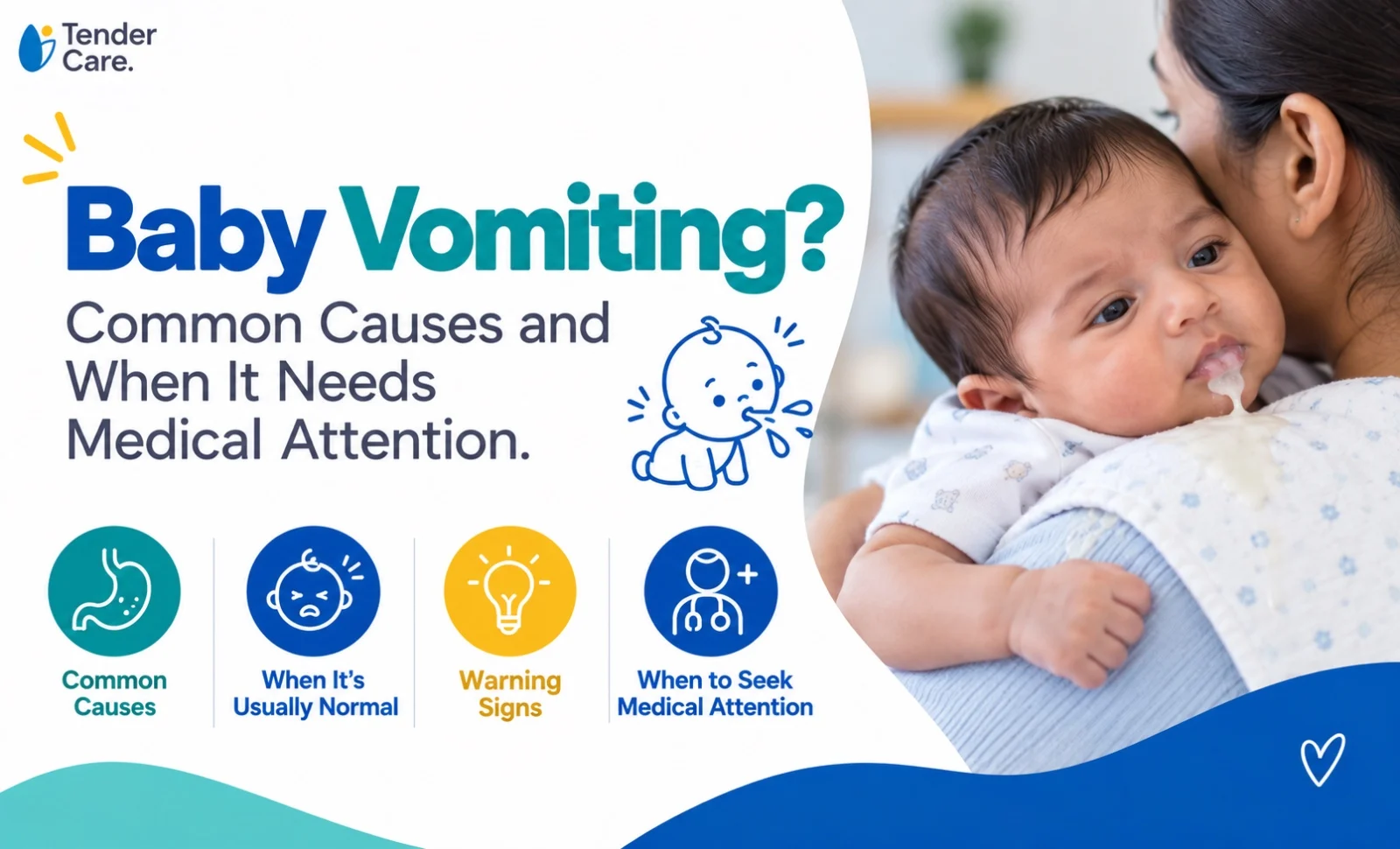
Baby vomiting can be worrying for parents, especially when it happens repeatedly or appears forceful. While occasional vomiting may occur because of feeding problems, reflux, overfeeding, or a minor stomach infection, vomiting in babies can sometimes indicate a condition that needs prompt medical attention. Understanding the difference between normal spit-up and true vomiting, knowing the common causes, and recognising warning signs in babies can help parents decide when to monitor the child at home and when to consult a pediatrician.
If your baby is vomiting repeatedly, refusing feeds, becoming unusually sleepy, developing a swollen abdomen, or showing signs of dehydration, do not delay medical evaluation. Parents can consult the pediatric team at Tender Care Hospital, Bhopal, which provides pediatric, neonatal, NICU, emergency, and pediatric surgical care. The hospital has experienced pediatric and neonatal specialists, including Dr Dipankar Sarkar, Dr Shruti Sarkar, and Dr Vijaya Beohar, along with visiting pediatricians.
What Is Baby Vomiting?
Vomiting in babies is the forceful expulsion of stomach contents through the mouth. It is different from spit-up, which is usually a small amount of milk that flows out of the baby’s mouth without force and is common in young infants. Vomiting may involve stronger abdominal contractions and can occur suddenly, sometimes with crying, discomfort, or other symptoms such as fever, diarrhoea, poor feeding, or lethargy.
Occasional vomiting does not always mean that a baby has a serious illness. However, babies can become dehydrated more quickly than older children, so repeated vomiting requires careful observation. The age of the baby, frequency of vomiting, colour of the vomit, associated symptoms, feeding pattern, urine output, and overall behaviour are important when determining whether medical assessment is needed.
Baby Vomiting vs Spit-Up: What Is the Difference?
Parents often use the words vomiting and spit-up interchangeably, but they are not exactly the same. Spit-up generally involves a small quantity of milk coming back up easily, often shortly after feeding. The baby usually remains comfortable, continues feeding normally, and continues to gain weight. Vomiting, on the other hand, is usually more forceful and may involve a larger amount of stomach contents.
Parents should pay attention to changes from the baby’s usual pattern. If a baby who normally has mild spit-up suddenly develops forceful or repeated vomiting, refuses feeds, becomes unusually irritable or sleepy, develops fever, or produces fewer wet diapers, medical advice should be sought.
Common Causes of Vomiting in Babies
There are several possible reasons for baby vomiting, ranging from common feeding-related issues to conditions that require medical treatment. The cause cannot always be identified from vomiting alone, which is why persistent or severe symptoms should be evaluated by a pediatrician.
Gastroesophageal Reflux
Gastroesophageal reflux (GER) is common in young babies because their digestive system is still developing. Milk and stomach contents can sometimes move back from the stomach into the oesophagus, causing spit-up or occasional vomiting, particularly after feeds.
Mild reflux may not be a major concern if the baby is otherwise comfortable, feeding well, producing normal wet diapers, and gaining weight appropriately. However, frequent vomiting accompanied by poor weight gain, feeding difficulties, breathing problems, significant discomfort, or other concerning symptoms requires pediatric evaluation.
If your baby frequently brings up milk or vomits after feeds and you are concerned about baby reflux, consult a pediatrician rather than assuming that every episode is normal. The pediatric team at Tender Care Hospital, Bhopal can assess feeding-related symptoms and determine whether further evaluation is necessary.
Viral Gastroenteritis and Stomach Infections
A viral stomach infection can cause vomiting in babies and may also be associated with diarrhoea, fever, poor appetite, or irritability. Vomiting may occur several times during the initial stage of an infection.
The main concern with repeated vomiting due to infection is dehydration. Babies have smaller fluid reserves than adults, so continued vomiting and diarrhoea can lead to fluid loss relatively quickly. Parents should monitor wet diapers, feeding, alertness, mouth moisture, and tears.
If your baby is vomiting repeatedly during a suspected stomach infection, particularly when the baby is unable to keep feeds down or is producing significantly fewer wet diapers, consult a pediatrician promptly.
Overfeeding or Feeding Too Quickly
Overfeeding is another common reason for vomiting or excessive spit-up in babies. A baby’s stomach is small, and giving more milk than the baby can comfortably tolerate may result in milk coming back up.
Feeding too quickly, swallowing excessive air, or immediately changing the baby’s position after feeding can also contribute to feeding-related vomiting or spit-up. Parents should follow age-appropriate feeding guidance and discuss persistent feeding difficulties with a pediatrician.
Pyloric Stenosis
Pyloric stenosis is an important cause of forceful vomiting in young infants. It occurs when the muscle at the outlet of the stomach becomes abnormally thickened, making it difficult for food to pass normally into the intestine.
It commonly develops during the first few months of life and can cause progressively forceful or projectile vomiting, often after feeding. A baby may appear hungry again soon after vomiting but may gradually develop dehydration or poor weight gain.
If your baby has repeated forceful vomiting, especially during the first few months of life, consult a pediatrician without delay. Tender Care Hospital, Bhopal, has pediatric and neonatal care facilities for evaluating babies with concerning vomiting and other acute symptoms.
Food Protein Intolerance
Some babies may develop vomiting or digestive symptoms because of an intolerance or sensitivity to certain food proteins. Depending on the condition, symptoms may also include diarrhoea, blood or mucus in the stool, excessive crying, feeding difficulties, skin symptoms, or poor weight gain.
Parents should not independently eliminate multiple foods from a breastfeeding parent’s diet or change formula repeatedly without professional guidance. A pediatrician can review the baby’s feeding history and symptoms and decide whether a food-related problem should be investigated.
Other Possible Causes of Baby Vomiting
Although reflux, infections, overfeeding, pyloric stenosis, and food intolerance are common considerations, vomiting can occur for many other reasons. The significance depends heavily on the baby’s age and the symptoms occurring alongside vomiting.
Possible causes can include:
- Fever or infection
- Feeding difficulties
- Milk or food intolerance
- Gastrointestinal infections
- Constipation or digestive problems
- Medication-related reactions
- Head injury or neurological problems
- Intestinal obstruction
- Congenital gastrointestinal conditions
- Other medical or surgical conditions
This is why parents should avoid trying to diagnose the exact cause based only on the appearance of vomit. A pediatrician may need to assess the baby’s medical history, feeding pattern, hydration status, abdominal examination, weight, temperature, and other symptoms.
When Does Baby Vomiting Need Medical Attention?
Not every episode of vomiting requires an emergency visit, but repeated or unusual vomiting in a baby should be taken seriously. Parents should contact a pediatrician when vomiting is persistent, becoming more frequent, affecting feeding, or associated with changes in the baby’s behaviour or urine output.
Seek medical advice if your baby:
- Vomits repeatedly during the day.
- Is unable to keep breast milk or formula down.
- Refuses feeds or feeds significantly less than usual.
- Has fewer wet diapers than normal.
- Has a dry mouth or tongue.
- Produces few or no tears when crying.
- Becomes unusually sleepy, weak, or difficult to wake.
- Has persistent crying or appears to be in significant pain.
- Develops fever along with repeated vomiting.
- Has diarrhoea along with frequent vomiting.
- Has a swollen or unusually firm abdomen.
- Has poor weight gain or appears increasingly weak.
- Develops forceful or projectile vomiting.
If your baby is showing any of these symptoms, do not wait for vomiting to resolve on its own. Tender Care Hospital, Bhopal, offers pediatric and neonatal services, including round-the-clock pediatric care and emergency support.
Emergency Warning Signs in a Vomiting Baby
Some types of vomiting require urgent medical attention because they may indicate dehydration, gastrointestinal obstruction, infection, bleeding, or another serious condition.
Green or Bilious Vomit
Green-coloured vomit can indicate the presence of bile and may be associated with an intestinal obstruction or another gastrointestinal problem. This should be treated as a warning sign, particularly in a newborn or young infant.
Parents should seek urgent medical assessment rather than waiting to see whether the vomiting stops.
Blood in Vomit
Bright red blood, dark blood, or material resembling coffee grounds in vomit requires medical evaluation. Blood in vomit can have different causes, and the baby should be assessed to determine the source.
Signs of Dehydration
Babies can become dehydrated quickly when they repeatedly vomit. Warning signs include:
- No wet diaper or no urine for an unusually long period
- Dry mouth or tongue
- Few or no tears when crying
- Sunken-looking eyes
- Unusual sleepiness or weakness
- Poor feeding
- Reduced urine output
If you suspect dehydration, seek medical care promptly.
Baby Under 12 Weeks With Repeated Vomiting
Repeated vomiting in a very young infant, particularly a baby under 12 weeks of age, deserves prompt medical attention. Young babies can deteriorate quickly, and vomiting may sometimes be associated with infection or another underlying condition.
Lethargy or Reduced Responsiveness
A baby who becomes unusually sleepy, weak, difficult to wake, or less responsive than normal after repeated vomiting should be assessed urgently.
Severe Abdominal Pain or Swelling
A swollen, distended, or unusually firm abdomen, especially when associated with vomiting, persistent crying, or severe discomfort, can be a sign of a gastrointestinal problem that requires immediate evaluation.
If your baby has green vomit, blood in the vomit, severe abdominal swelling, significant dehydration, or unusual lethargy, seek urgent medical attention rather than attempting home treatment.
What Should Parents Do When a Baby Vomits?
The first step is to remain calm and observe the baby carefully. Parents should note how often the baby vomits, what the vomit looks like, when it occurs in relation to feeding, whether the baby has fever or diarrhoea, and whether the baby is passing urine normally.
Depending on the baby’s age and medical condition, a healthcare professional may provide specific feeding and fluid recommendations. Parents should not give medicines, anti-vomiting drugs, home remedies, or other treatments to a baby without medical advice.
Important steps include:
- Keep track of wet diapers and urine output.
- Monitor whether the baby is accepting breast milk or formula.
- Observe the baby’s alertness and behaviour.
- Note the colour and appearance of vomit.
- Record how frequently vomiting occurs.
- Tell the doctor about any fever, diarrhoea, cough, rash, or other symptoms.
- Seek medical advice if vomiting is repeated or worsening.
- Get emergency care for serious warning signs.
When Should Parents Take a Vomiting Baby to a Hospital?
Parents should seek hospital care when vomiting is repeated, forceful, associated with dehydration, accompanied by green or bloody vomit, or associated with severe abdominal symptoms. Very young infants also require a lower threshold for medical evaluation because their condition can change rapidly.
A pediatric assessment can help determine whether the vomiting is related to a common feeding issue or whether further investigations are necessary. Depending on the symptoms, the doctor may evaluate hydration, weight, temperature, abdominal findings, feeding history, and other clinical signs.
Pediatricians at Tender Care Hospital, Bhopal
Tender Care Hospital, Bhopal has a dedicated pediatric and neonatal care team for newborns, infants, and children. The hospital lists senior pediatric and neonatal specialists as well as visiting pediatricians who provide care for a range of childhood conditions.
Dr Dipankar Sarkar
Dr Dipankar Sarkar is a senior consultant in neonatology at Tender Care Hospital. He has an MD from GMC Bhopal and has received training in neonatology in the UK and Australia. His experience includes work at Apollo and academic experience as a professor of pediatrics.
Parents concerned about vomiting in newborns, feeding problems, neonatal symptoms, or other newborn health concerns can seek appropriate medical evaluation from an experienced neonatal specialist.
Dr Shruti Sarkar
Dr Shruti Sarkar is a senior consultant in Pediatrics and Neonatology. She has an MD in Pediatrics from GMC Bhopal and has received training in pediatrics and neonatology in the UK, along with pediatric hematology training at RCH Melbourne. Her experience also includes pediatric psychology and academic pediatrics.
Dr Vijaya Beohar
Dr Vijaya Beohar is an experienced pediatric specialist with an MD and previous academic experience as Associate Professor and Professor of Pediatrics at institutions including GMC Bhopal, RD Gardi Medical College Ujjain, and People’s College Bhopal.
If your baby’s vomiting is persistent, forceful, or accompanied by other concerning symptoms, consult a pediatrician at Tender Care Hospital, Bhopal, for timely assessment rather than relying on home remedies or self-medication.
How Is the Cause of Baby Vomiting Diagnosed?
The diagnosis depends on the baby’s age, symptoms, medical history, feeding pattern, and physical examination. A pediatrician will usually ask parents about when the vomiting started, how often it occurs, whether it happens after feeding, the amount and colour of the vomit, feeding tolerance, urine output, stool pattern, fever, and changes in behaviour.
The doctor may also assess the baby’s weight and hydration status and examine the abdomen. Depending on the suspected cause, additional tests may be recommended. For example, a baby with persistent forceful vomiting may require further evaluation to rule out conditions such as pyloric stenosis or another gastrointestinal problem.
Parents should provide as much information as possible because details about the vomiting pattern can help the pediatrician identify the likely cause.
Baby Vomiting With Fever or Diarrhoea
Vomiting accompanied by fever or diarrhoea may occur with an infection, including viral gastroenteritis. However, the presence of these symptoms does not automatically establish the cause.
The primary concern is fluid loss and dehydration. Parents should monitor feeding and urine output closely and seek medical advice if vomiting continues, the baby cannot retain feeds, urine output decreases, or the baby becomes unusually sleepy or weak.
If vomiting and diarrhoea are severe or persistent, consult a pediatrician promptly. Tender Care Hospital, Bhopal, provides pediatric and emergency care for children and newborns and has facilities including NICU and pediatric services.
How Can Parents Help Prevent Feeding-Related Vomiting?
Not all vomiting can be prevented, particularly when it is caused by an infection or an underlying medical condition. However, parents can discuss feeding practices with their pediatrician if vomiting or frequent spit-up occurs around feeding.
Depending on the baby’s individual needs, parents may be advised to:
- Follow an age-appropriate feeding schedule.
- Avoid overfeeding.
- Follow appropriate breastfeeding or formula-feeding guidance.
- Pay attention to the baby’s feeding cues.
- Discuss frequent spit-up or vomiting with a pediatrician.
- Avoid giving medicines without medical advice.
- Monitor the baby’s growth and wet diapers.
- Seek medical care if the vomiting pattern changes suddenly.
If your baby is vomiting repeatedly or you are unsure whether the symptoms are normal, consult a pediatrician at Tender Care Hospital, Bhopal for professional evaluation. The hospital provides pediatric, neonatal, NICU, pediatric surgical, and emergency services for children and newborns.
Baby Vomiting FAQs
Is vomiting normal in babies?
Occasional spit-up is common in babies, but true or repeated vomiting should be monitored carefully. Forceful vomiting, poor feeding, dehydration, fever, lethargy, green vomit, or blood in vomit requires medical attention.
How can I tell if my baby is vomiting or just spitting up?
Spit-up usually comes out easily and involves a small amount of milk, while vomiting is generally more forceful and may involve abdominal contractions. If you are unsure, a pediatrician can help determine whether the baby’s symptoms are concerning.
When should I worry about baby vomiting?
Parents should seek medical advice when vomiting is repeated, forceful, associated with poor feeding, reduced urine output, fever, diarrhoea, lethargy, abdominal swelling, or poor weight gain. Green or bloody vomit requires urgent medical evaluation.
Is projectile vomiting in babies serious?
Projectile vomiting can sometimes indicate a condition such as pyloric stenosis, particularly in young infants. Repeated forceful vomiting should be evaluated by a pediatrician.
What does green vomit mean in a baby?
Green vomit may contain bile and can be associated with an intestinal obstruction or another gastrointestinal problem. A baby with green or bilious vomiting should receive urgent medical assessment.
Can dehydration happen because of vomiting?
Yes. Babies can become dehydrated from repeated vomiting, especially when they are also experiencing diarrhoea or are unable to keep feeds down. Reduced wet diapers, dry mouth, few tears, and unusual sleepiness are important warning signs.
Should I give medicine to my baby for vomiting?
Parents should not give anti-vomiting medicines or other medication to a baby without medical advice. The appropriate treatment depends on the cause of vomiting, the baby’s age, hydration status, and overall condition.
When should I take my vomiting baby to a hospital?
Take your baby for urgent medical evaluation if there is green vomit, blood in the vomit, severe or persistent vomiting, significant dehydration, unusual lethargy, severe abdominal pain, abdominal swelling, or other serious symptoms.
Which doctors can treat vomiting in babies at Tender Care Hospital, Bhopal?
Tender Care Hospital’s pediatric and neonatal team includes Dr Dipankar Sarkar, Dr Shruti Sarkar, and Dr Vijaya Beohar, along with visiting pediatricians including Dr Aarti Sharma, Dr Chitra Soni, Dr Shubangam Sharma, Dr Ankush Jain, Dr Mohini Malhotra, and Dr Aapurti Awasthi. The hospital also has pediatric surgical specialists including Dr Ashwin Apte and Dr Saket Jha.
Where can parents seek pediatric care for a vomiting baby in Bhopal?
Parents can consult the pediatric and neonatal team at Tender Care Hospital, Bhopal, which provides Pediatrics, Neonatology, NICU, Pediatric Surgery, and 24×7 emergency care.