
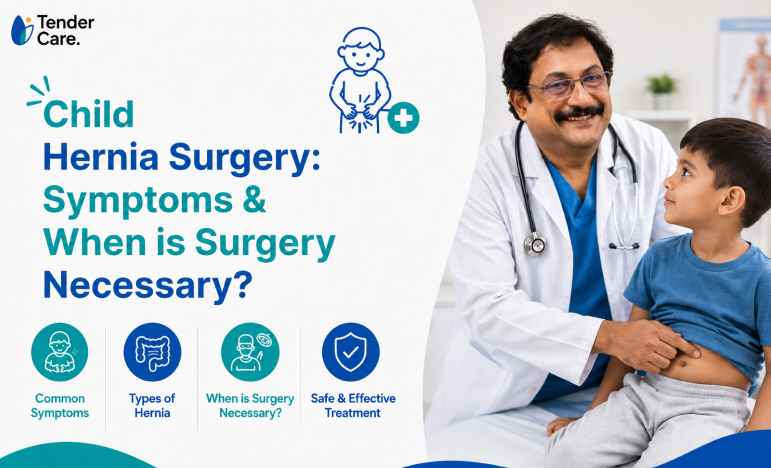
A swelling or bulge in your child’s groin, abdomen, or around the belly button can naturally make you concerned. One possible reason is a hernia, a condition in which an internal organ or tissue pushes through a weak area in the surrounding muscle.
Childhood hernias are generally treatable, but the right approach depends on the type of hernia, the child’s age, symptoms, and whether the hernia can be pushed back easily.
At Tender Care Hospital, parents can consult the pediatric surgery team, including Dr. Ashwin Apte (MBBS, MS, MCh – Pediatric Surgery), for an appropriate assessment and treatment plan.
What Is a Hernia in Children?
A hernia in children occurs when an organ, tissue, or part of the intestine pushes through a weak area in the muscle or tissue that normally keeps it in place. It may appear as a small lump or swelling, commonly around the groin, abdomen, or belly button.
In children, many hernias are related to the development of the abdominal wall before birth. Some are noticed soon after birth, while others become visible later when the child cries, coughs, strains, or becomes physically active.
Also Read:- How to Take Care of a Premature Baby
What Causes Hernia in Children?
Childhood hernias can develop for several reasons. In many cases, the weakness or opening responsible for the hernia develops before birth rather than being caused by normal childhood activities.
Common factors include:
- Incomplete closure of an abdominal opening during development before birth.
- Premature birth, which may increase the risk of certain childhood hernias.
- A natural weakness in the abdominal wall.
- Increased pressure inside the abdomen due to persistent coughing or straining.
- Certain medical or developmental conditions that may increase the likelihood of developing a hernia.
Common Symptoms of Hernia in Children
The most noticeable symptom is usually a visible lump or swelling in the affected area.
Parents may notice:
- A bulge in the groin or abdomen.
- Swelling that becomes more noticeable when the child cries, coughs, or strains.
- A bulge that becomes smaller or disappears when the child relaxes or lies down.
- Pain or discomfort around the swelling.
- Irritability or unusual crying in infants.
- In complicated cases, symptoms such as vomiting, abdominal pain, or difficulty passing stool or gas.
A painless swelling should still be examined because some hernias can become trapped or complicated.
Types of Hernia Commonly Seen in Children
Children can develop different types of hernias. Inguinal and umbilical hernias are among the commonly encountered types.
Inguinal Hernia
An inguinal hernia develops in the groin when abdominal tissue or intestine passes through an opening in the lower abdominal wall.
Parents may notice a swelling in the groin or, in boys, swelling that extends towards the scrotum. Inguinal hernias in children generally need surgical evaluation because they can become trapped.
Umbilical Hernia
An umbilical hernia develops around the belly button, through the opening where the umbilical cord was attached.
Many small umbilical hernias in young children may close naturally as the abdominal muscles develop. However, larger, persistent, symptomatic, or complicated hernias may require surgery.
Other Childhood Hernias
Children can also develop less common types of abdominal wall hernias. The appropriate treatment depends on the location, size, symptoms, age of the child, and risk of complications.
Also Read:- Best Pediatric Surgeon in Bhopal
When Is Hernia Surgery Necessary for a Child?
Not every childhood hernia requires immediate surgery. The decision depends mainly on the type of hernia, the child’s age, symptoms, and risk of complications.
For example, an inguinal hernia generally requires surgical repair because it does not usually close on its own and can become incarcerated or strangulated.
For an umbilical hernia, doctors may recommend observation in some young children, particularly when the hernia is small and uncomplicated.
Surgery may be recommended when:
- The hernia is unlikely to close naturally.
- The hernia remains large or persistent.
- The swelling becomes painful or difficult to push back.
- Tissue or intestine becomes trapped inside the hernia.
- There are signs that the blood supply may be affected.
- The child develops recurrent symptoms or complications.
At Tender Care Hospital, the pediatric surgery team can assess the child’s condition and determine whether observation or surgical repair is appropriate.
How Is Hernia Diagnosed in Children?
Most childhood hernias can be diagnosed through a physical examination.
The doctor may:
- Ask when the swelling was first noticed.
- Check whether it becomes more prominent when the child cries, coughs, stands, or strains.
- Examine the location and size of the swelling.
- Check whether the swelling can be gently reduced.
- Look for signs of pain, tenderness, or complications.
In straightforward cases, additional tests may not be required. However, an ultrasound or other imaging test may sometimes be recommended when the diagnosis is unclear or further evaluation is needed.
What Happens During Child Hernia Surgery?
Child hernia surgery involves repairing the opening or weak area through which the tissue is protruding.
The exact procedure depends on the type and location of the hernia.
For an inguinal hernia, the pediatric surgeon identifies the hernia sac, carefully separates it from surrounding structures, and closes the abnormal opening. In selected cases, laparoscopic surgery may be considered.
For an umbilical hernia, the surgeon repairs the opening in the abdominal wall and closes the area securely.
Children generally undergo hernia repair under general anaesthesia, meaning the child is asleep during the procedure.
Recovery After Hernia Surgery in Children
Most children recover well following hernia repair, although recovery can vary according to the child’s age, type of hernia, surgical technique, and overall health.
Parents may be advised to:
- Keep the surgical area clean and dry as instructed.
- Give prescribed medicines according to the doctor’s instructions.
- Encourage adequate fluids and age-appropriate food.
- Prevent the child from scratching or irritating the wound.
- Follow instructions about bathing and physical activity.
- Attend scheduled follow-up appointments.
Book an Appointment for Child Hernia Consultation at Tender Care Hospital
If your child has a swelling or bulge in the groin, abdomen, or around the belly button, it is important to get it evaluated by a pediatrician or pediatric surgeon. Early assessment can help determine the type of hernia and whether observation or surgical repair is appropriate.
At Tender Care Hospital, Bhopal, pediatric and neonatal surgical services are available, including treatment for childhood hernia.
Parents can schedule a consultation to discuss symptoms such as a groin swelling, umbilical bulge, pain, or a swelling that becomes more noticeable when the child cries or strains. During the consultation, the doctor can examine the child and explain whether further tests or surgery may be required.
Child Hernia Surgery: Symptoms & When is Surgery Necessary? FAQs
Q. What is the most common symptom of a hernia in a child?
A visible or palpable swelling in the groin, abdomen, or around the belly button is one of the most common symptoms. It may become more noticeable when the child cries, coughs, or strains.
Q. Do all children with a hernia need surgery?
No. Treatment depends on the type of hernia, age of the child, size, symptoms, and risk of complications. Some umbilical hernias may close naturally, while inguinal hernias generally require surgical repair.
Q. Is child hernia surgery safe?
Hernia repair is a commonly performed pediatric surgical procedure. However, every surgery has potential risks. The pediatric surgeon will assess the child and explain the expected benefits and possible risks before the procedure.
Q. Can a child’s hernia heal on its own?
Some small umbilical hernias can close naturally as the child grows. An inguinal hernia generally does not close on its own and should be evaluated by a pediatric surgeon.
Q. How long does child hernia surgery take?
The duration varies according to the type of hernia, surgical technique, and individual condition of the child. The pediatric surgeon can provide a more specific estimate after evaluation.